
Hey friends,
I usually write about the first sales team. The exit from founder-led sales. The first AE. The first hire.
Not today.
Today I want to write about something past 10-20M ARRn - a scale-up play.
The stage where you have a CSM team.
A renewal motion.
Twelve months of data on what your customers actually do after they sign.
The stage where your AEs are no longer just hunters, they are part of a longer chain.
Pay on bookings. Pay at signature. Closed won.
That is the rule everyone copies.
To be honest - It works fine...until it doesn't.
At the scale-up stage, a different pattern shows up.
Your AEs hit quota. Bookings look great.
Then, nine months later, half the cohort churns. You have got a massive churn.
The number that matters at this stage is net revenue retention, and your AEs have zero skin in that game.
They getting money for closing, while CSM is fighting to keep those accounts live.
The AEs and CSM teams blame each other.
I have seen this. (literally - seen and lived on my skin).
Most sales leaders (me included) will tell you AEs should be paid on new logos only, and renewals belong to CS.
I may disagree at this stage.
Once you cross €20-30M ARR, your AEs should be paid (also) on the full lifetime of the customer.
This is called the bow tie model from Winning by Design - imagine a bow tie:
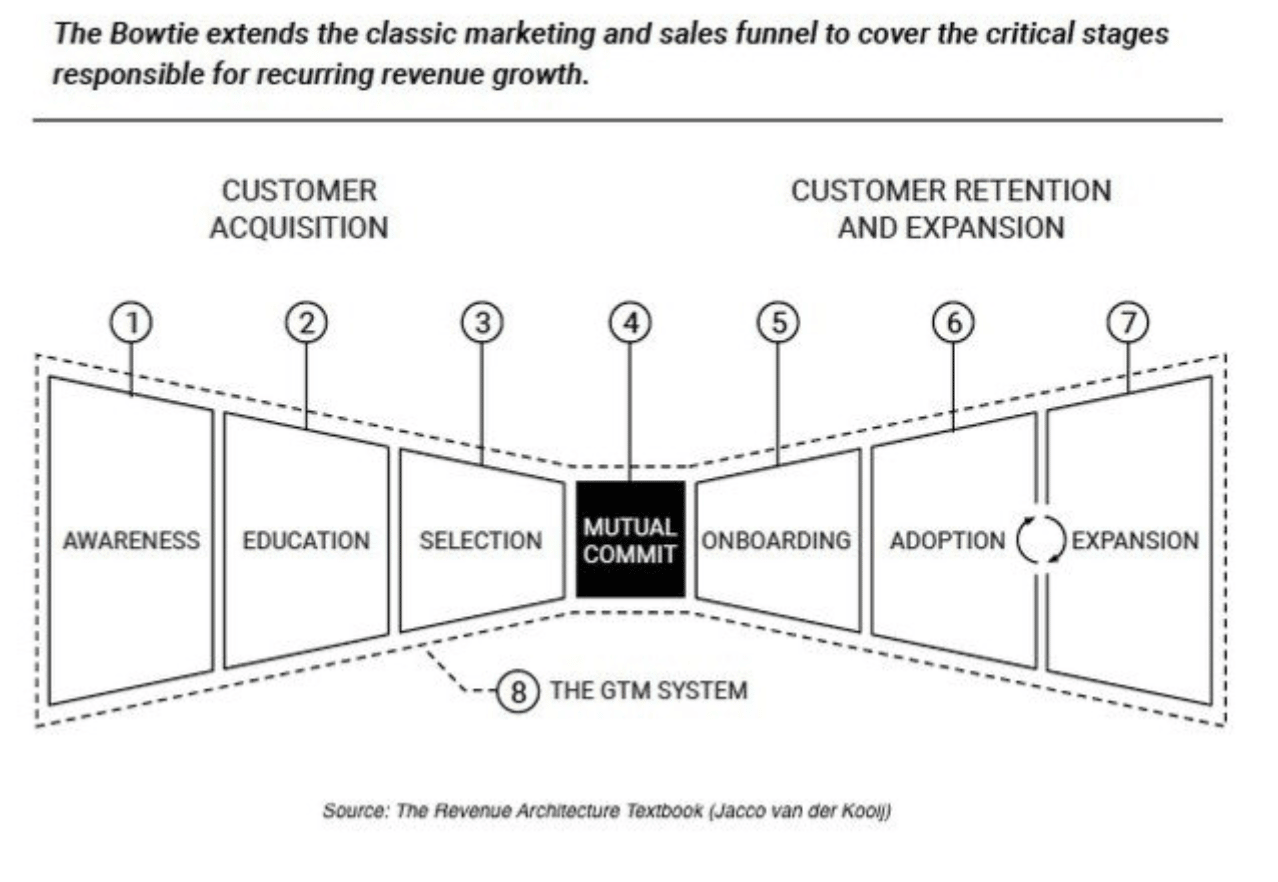
The deal does not end at signature.
The deal closes at the second renewal.
Everything before is the front half of the bow tie.
The back half, onboarding, adoption, expansion, renewal, is where most of the value sits.
Three changes for your sales commission plan.
You have CS in place to do the back half of the bow tie.
You have data on what good retention looks like. You have a renewal cycle long enough to measure.
You have the cash to pay 30% twelve months later without putting pressure on the AE.
None of this is true at €1M ARR.
Do not copy this plan early.
Without a real renewal motion, you are gating commission on something the AE cannot influence, and you will lose them.
Most companies hit a wall when they scale up.
CS is overwhelmed. AEs disappear after closing. NRR drops below 100.
Adding more CS headcount does not fix it.
You change the comp plan, you change the behaviour.
AEs who get paid on renewal qualify harder.
They close better-fit deals.
They run cleaner handovers and choose carefully the accounts they want to work on optimising for later not for closing.
LTV goes up. NRR holds.
If you are too early, this is not for you, but if you are scaling up, I’d think about this for FY2027.
Let me know how it goes.
Thanks for reading this far. See you all next week!

